


Markvinia, Klesarija u Biogradu na Moru, od 1964.
Polishing a granite slab in the Markvinia production works
  The stone

We value natural stone for its durability and its beauty. A short guide to the kinds, strength and hardness.

  1. 1–10Mohs hardness scale
  2. 2.75 g/cm³Density of granite
  3. ~1 %Absorption, low porosity
The stone

An eternal material.

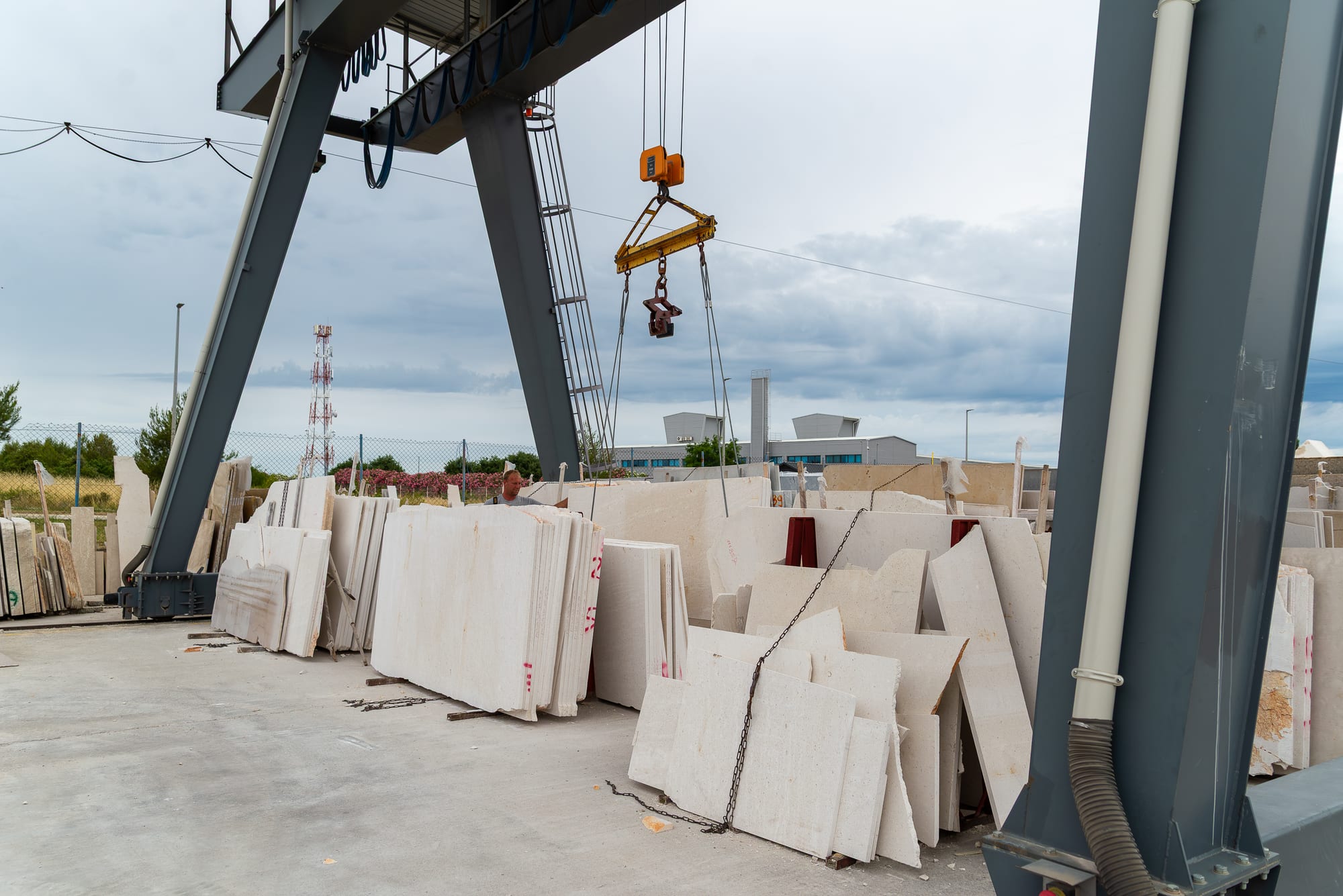
We value natural stone for its durability and its beauty. Stone is an eternal material. The many buildings from the past that have survived precisely because of it are proof of this. Most were made of the massive stone rarely used today; now cut slabs are more common, finished by polishing, bush-hammering, sandblasting or flaming.

The present-day use of stone comes down to the cladding of floors, walls, staircases, columns, gravestones and other architectural elements. There are several kinds of floor stone, and we mostly divide them into granites and marbles.

Natural stone, with its own pronounced patterns, is unique in itself and is at its most beautiful when laid simply.

01

Granite

The word granite comes from Latin, pointing to the coarse-grained structure of the crystalline rock. Granite is a common and very widespread type of igneous (volcanic) rock. It is usually medium to coarsely crystalline and can range from pale pink to black shades, depending on its chemical and mineral composition.

It is harder than marble and limestone, and so is better suited to paving business premises and other spaces with high foot traffic. Granite is almost always massive, solid and hard, which is why its use as a building and decorative stone is so widespread. The average density of granite is 2.75 g/cm³, varying up to 2.80 g/cm³. Granites suit indoor and outdoor paving, the cladding of staircases, counters and facades, and kitchen worktops.
02

Marble and limestone

Marble is a rock formed by the metamorphism of carbonate protoliths and the sedimentary rocks limestone and dolomite under raised temperature and pressure. It has a grainy structure and a homogeneous texture, is used in sculpture and building, and is easily cut, worked and polished.

In art the marble from Carrara is prized, the stone from which Michelangelo's David was carved. Here at home the best known is the Brač stone, prized the world over, although by its composition it does not belong to the marble group but to the limestone group. Marbles are among the most beautiful kinds of stone.

Limestone is a sedimentary rock made up of the mineral calcite, with small amounts of other minerals. Marbles and limestones are exceptionally decorative and refined, though sensitive. Porphyrites and quartzites are most often used for outdoor floors, steps, pool edges and cladding, while sandstones and travertines, because of their porosity, are most suited to cladding.

03

Strength

Strength is a rock's resistance to a force placed under pressure. With regard to the forces that can act on stone, we distinguish compressive force and bending strength, as well as resistance to fracture. A few examples of the magnitude of pressure on particular rocks:

Sandstones
500–1800 kg/cm²
Marbles
600–2000 kg/cm²
Granites
1500–2700 kg/cm²
Diorites
200–2700 kg/cm²
Basalt
2500–3500 kg/cm²
04

Hardness

Hardness denotes a rock's resistance to wear, and depends on the hardness of the minerals and their structure. The degree of hardness is set on a scale from 1 to 10 on the Mohs scale, where higher numbers denote greater hardness. By the difference in hardness we distinguish:

1–2
Soft rocksgravel, gypsum, chalk
3–4
Semi-hard rockslimestones, dolomites, marbles
5–7
Hard rocksgranite, diorite, syenite
above 7
Very hard rocksporphyry, basalt, diabase

Wear is a very important consideration when choosing a rock for trafficked surfaces. The abrasion coefficient is determined by test grinding: a low coefficient denotes a high degree of wear, and a high coefficient a low degree of wear.

05

Water absorption

Every rock in nature contains a certain amount of moisture, and that is not harmful. A rock with a low degree of porosity holds about 1 % moisture. The property of water absorption matters above all in rocks with medium and high porosity: such materials are considerably less resistant to frost and so become less durable.

Igneous rocks (granites and porphyries) belong to the harder, more durable rocks, with a low capacity for water absorption and a low degree of wear. Sedimentary rocks (limestones, sandstones) hold many patterns from deposits and the remains of stone, shells and sand, so they look more beautiful and suit indoor cladding. Metamorphic rocks (marbles and quartzites) are recrystallised igneous and sedimentary rocks, in principle more stable than sedimentary rocks.

If you are hesitating between two or three options,get in touch or come to the showroom: samples under natural light always show what a photograph cannot.

05Process

From the quarry
to the site.

Four steps, one roof. Each stage has its own tool, its own technique and its own measure. No shortcuts, no subcontractors on the cuts that matter.

  1. Quarry

    A block of stone is chosen at the source: Brač, Carrara, Biograd, elsewhere.

  2. Works

    It is cut and polished in Biograd na Moru, where the machines work better than the hand.

  3. Workshop

    The detail by hand, where that makes sense. A mason’s craft, not automation.

  4. Site

    It is set in place: gravestone, facade, fireplace, terrace, floor.

Contact

Not sure which stone to choose?

Send an enquiry or call. We advise you with no obligation.